When a supply line fails in a Valley Village home
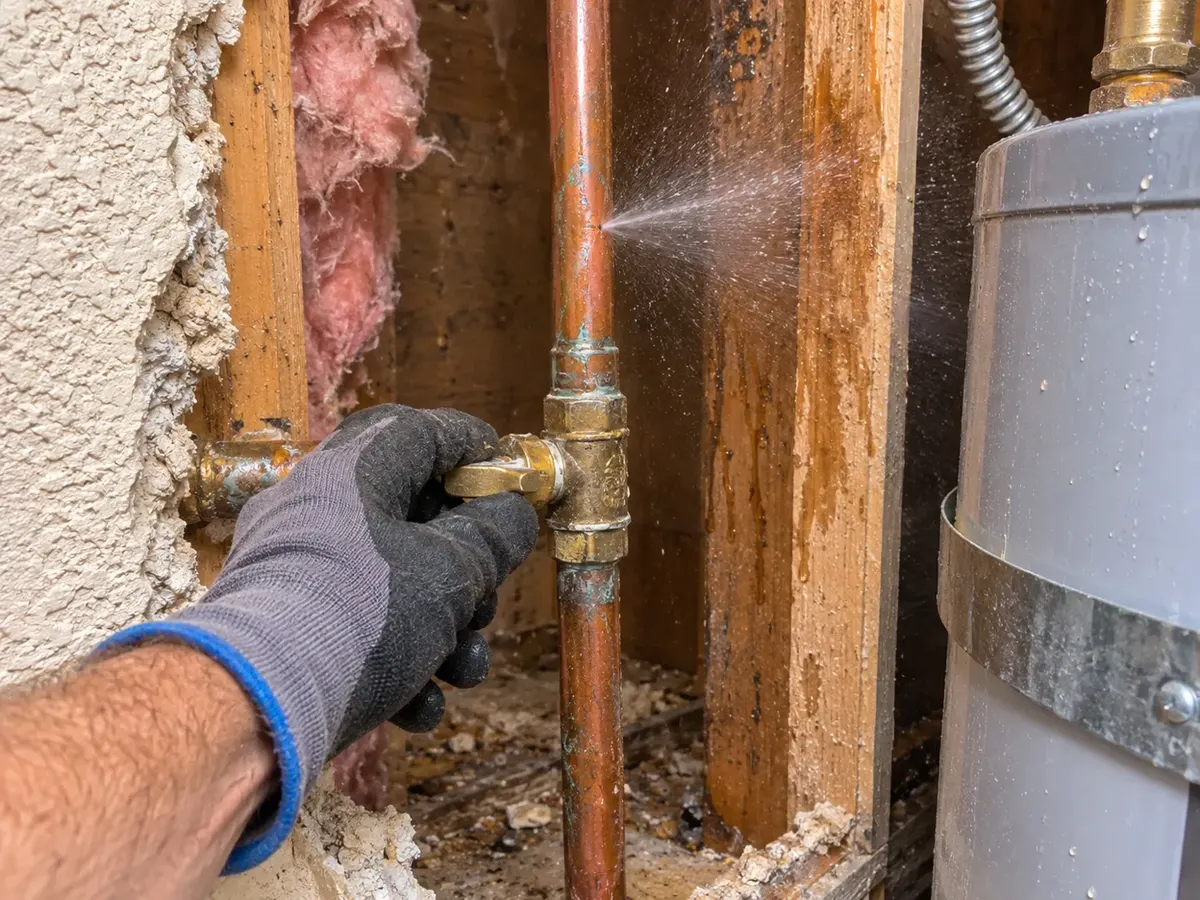
A burst pipe is two jobs: a plumber fixes the pipe, and a restoration company handles the water. In Valley Village, the water side is extraction, opening walls where water ran down the cavity, and drying.
Water from a supply line starts as clean, Category 1 water, but time and temperature can change the category[IICRC 2026 position statement]. Fast extraction keeps more drywall and flooring in the dry-in-place column.
If your Valley Village home has a raised floor, check below it too. Water from a failed line under a sink or tub can drip through the subfloor into the crawl space, where it stays out of sight.
How the job usually runs
- Shut off the main. Know where it is before you need it.
- Call a plumber. For the pipe itself.
- Extract and open up. Water removed; wet drywall and insulation cut out.
- Dry. Equipment runs until readings show dry.
Do
- Turn off the water heater if the main is off for long.
- Photograph the damage[FEMA].
Avoid
- Turning the water back on before the pipe is fixed.
- Using ceiling fixtures below a wet ceiling.
The first hour after you find water
- Shut off the source. Use the valve at the fixture first. If water keeps coming, close the main shut-off for the house.
- Stay safe. Do not walk through water near electrical outlets or appliances; disconnect appliances before power comes back on[CDC].
- Take pictures. Photograph and video the damage, room by room, before cleanup starts[FEMA].
- Protect belongings. Move rugs, electronics and paper goods to a dry area, and put furniture legs on blocks.
- Start drying fast. The EPA says to dry wet materials within 24 to 48 hours[EPA]. Water left longer moves further into floors and walls.
Do not use a household vacuum on standing water, and do not turn on ceiling fans or lights under a wet ceiling.
Common causes of water damage in Valley Village homes
- Supply lines. Braided and plastic supply lines under sinks and toilets fail at the connection. A failed line can run at full pressure until the valve is closed.
- Water heaters. When the tank or fittings leak, water spreads across the floor from the garage, closet or utility room.
- Washers. Old rubber hoses split, and a washer drain that backs up puts dirty water on the floor.
- Air conditioning. Condensate lines clog and drain pans overflow during long cooling seasons.
- Kitchen appliances. Ice maker lines and dishwasher hoses leak out of sight under the cabinets.
- Weather. Winter storms, roof leaks and street flooding. Contaminated wind-driven rain counts as Category 3 water[IICRC 2026 position statement].
Knowing the source tells the crew what category the water is and where to look for spread.
Leaks you cannot see in Valley Village homes
Water moves outward under walls and cabinets instead of draining down. A leak in a hall bath can show up as a damp closet two rooms away.
Air conditioning is a frequent source. The EPA advises keeping AC drip pans clean and drain lines flowing[EPA], and notes that pans which do not drain can let water into the system[EPA]. When the air handler sits in the attic, an overflowing pan usually shows up first as a ceiling stain.
Places to check:
- Water heater platforms and the floor around them
- Washer supply hoses and the wall behind them
- Sink cabinets and the floor under them
- Inside walls around pipes that leak or condense[EPA]
- Under flooring next to tubs, showers and toilets
LADWP’s leak tips include a simple toilet test: put food coloring in the tank, and if color shows up in the bowl without flushing, there is a leak that should be fixed[LADWP].
Slab floors and raised floors
Los Angeles City Planning’s history of postwar tract housing notes that these houses often have concrete slab floors rather than raised floors with wood joists[LA City Planning]. Much of the Valley was built in that era, so on many calls the water is on or under a slab.
Raised foundations show up more in older homes. Earthquake Brace + Bolt, the state program for retrofitting raised-foundation houses, uses the percentage of pre-1940 houses in a ZIP code as one of its selection criteria[Earthquake Brace + Bolt]. Water under a raised floor can sit unseen until the floor softens.
Either way, the drying plan changes: slab jobs focus on flooring, baseboards and the bottom of walls, while raised-floor jobs add the subfloor, joists and crawl space.
Structural drying in a dry climate
The EPA’s target is to dry wet materials within 24 to 48 hours[EPA]. A small clean-water leak caught early can often be dried in a few days. After a flood, the EPA warns that drying out can take several weeks[EPA flood cleanup guide].
Dry outdoor air is not the same as a dry wall. EPA guidance is to ventilate when outside air is cold and dry and to dehumidify when it is warm and humid[EPA], and the inside of a wet wall cavity or carpet pad still needs moving air and dehumidification to dry in time.
Leave the equipment running, keep doors to the drying area closed, and let the technician move it. Turning off air movers at night to cut noise can add days to the job.
Winter storms and roof leaks
Most Valley rain falls in a handful of winter storms. In February 2024, the National Weather Service recorded 4.10 inches at downtown Los Angeles on February 4 and another 2.93 inches on February 5, with 12.66 inches for the month, more than 9 inches above normal[NWS Los Angeles].
In heavy rain, the common entry points are roofs, skylights, window and door frames and garage thresholds. Ceiling water is the one to move on fast, because wet insulation and drywall above you add weight.
Do not stand under a sagging ceiling, and turn off power to rooms where water is near outlets or fixtures if you can do so safely[CDC].
Re-entering a flooded Valley Village home
Do not walk or drive through floodwater. The National Weather Service says 6 inches of fast-moving water can knock over an adult and 12 inches of rushing water can carry away most cars[NWS].
If there is standing water inside, be ready to turn off the power, and unplug appliances so they do not shock anyone when power returns[CDC]. Take photos and video of every room before cleanup starts[FEMA].
Burst pipe water damage and Valley Village homes
The Census Bureau counts 14,831 housing units in ZIP code 91607. 28% are detached single-family houses, 67% are in buildings with two or more units, and 30% of occupied homes are owner-occupied[U.S. Census Bureau]. 72% of homes in ZIP code 91607 were built before 1980 and the median year built is 1969[U.S. Census Bureau]. At that age, original galvanized or copper supply lines, cast-iron drains and older shut-off valves deserve a look.
Valley Village is part of the City of Los Angeles, so water comes from LADWP. Leaks at the street, the meter or a broken main are reported to LADWP at 1-800-DIAL-DWP (1-800-342-5397), where representatives answer outage and water trouble calls around the clock[LADWP].
Other services in Valley Village
- Water damage restoration in Valley Village
- Water extraction
- Flood restoration
- Crawl space water removal