Restoring a home after storm water in Woodland Hills
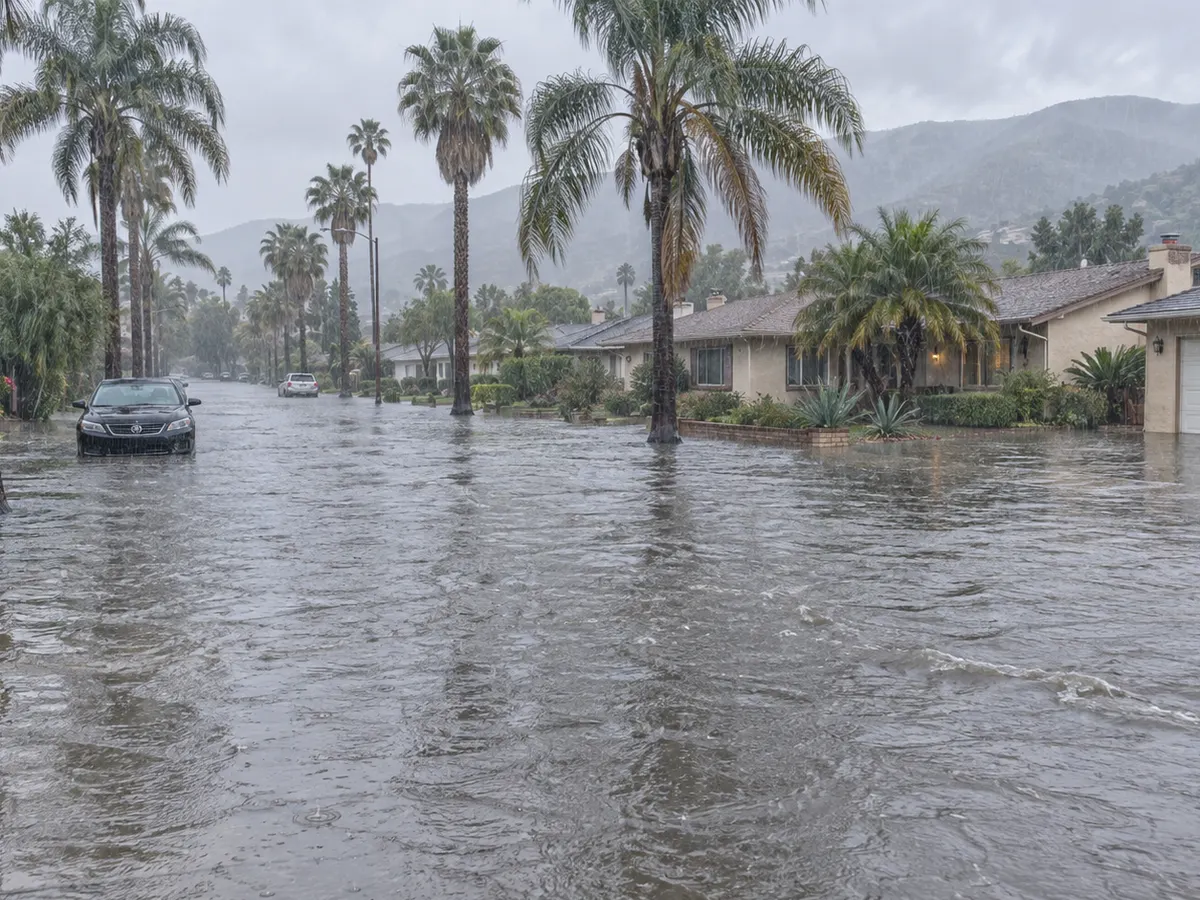
The IICRC lists rising water from rivers or streams as an example of Category 3 water, while storm water is not automatically Category 3; the restorer decides after inspecting[IICRC 2026 position statement]. Either way, floodwater calls for protective gear and removal of materials it soaked.
FEMA’s guidance is to document the damage, stay away from wet electrical equipment, and take out wet drywall and insulation[FEMA]. Work in Woodland Hills follows that order: safety, photos, removal, cleaning, drying.
Step by step
- Wait for safe entry. Do not go back in until officials say it is safe[FEMA].
- Document. Photos and video of every room.
- Remove. Wet drywall, insulation and flooring come out.
- Clean and dry. Surfaces cleaned, then dried to verified readings.
Do
- Wear rubber boots and gloves[CDC].
- Keep children and pets out of flooded rooms.
What to do first when water gets into a home in Woodland Hills
- Stop the water. Close the fixture valve under the sink or toilet, or the main shut-off if you cannot find the source. It helps to find the main shut-off before you ever need it.
- Make it safe. Keep away from outlets, cords and fixtures that water has reached, and turn off power at the breaker only if you can do it from a dry spot[CDC].
- Document it. Take photos and video of each room, the source and damaged belongings before anything is moved[FEMA].
- Move what you can. Lift furniture onto blocks or foil, pull rugs off wet carpet, and get photos, papers and electronics to a dry room.
- Call for restoration. Drying should start within 24 to 48 hours[EPA], and extraction works better before water soaks deeper into the pad and walls.
Leave large amounts of water to extraction equipment, and keep lights and ceiling fans off under any wet ceiling.
Signs you need water damage restoration, not just a mop
- Water has been sitting for more than a day, or you do not know how long it was there
- Carpet is wet across a room, or the pad squishes when you step on it
- Drywall is soft, stained or swollen at the bottom
- Water came through a ceiling or reached a second room
- The water came from a toilet, drain or the outside
- There is a musty smell after the surface has dried
These point to water inside the building materials. Surface drying will not reach it.
What usually causes water damage in Woodland Hills
- Supply lines. Braided and plastic supply lines under sinks and toilets fail at the connection. A failed line can run at full pressure until the valve is closed.
- Water heaters. When the tank or fittings leak, water spreads across the floor from the garage, closet or utility room.
- Washers. Old rubber hoses split, and a washer drain that backs up puts dirty water on the floor.
- Air conditioning. Condensate lines clog and drain pans overflow during long cooling seasons.
- Kitchen appliances. Ice maker lines and dishwasher hoses leak out of sight under the cabinets.
- Weather. Winter storms, roof leaks and street flooding. Contaminated wind-driven rain counts as Category 3 water[IICRC 2026 position statement].
Knowing the source tells the crew what category the water is and where to look for spread.
What is under the floor matters
Los Angeles City Planning’s history of postwar tract housing notes that these houses often have concrete slab floors rather than raised floors with wood joists[LA City Planning]. Much of the Valley was built in that era, so on many calls the water is on or under a slab.
Older houses are more likely to be raised. The state’s Earthquake Brace + Bolt program, which helps owners retrofit houses on raised foundations, ranks ZIP codes partly by the share of houses built before 1940[Earthquake Brace + Bolt]. In a raised-floor house, a leak can drip through the subfloor into the crawl space and stay hidden.
Either way, the drying plan changes: slab jobs focus on flooring, baseboards and the bottom of walls, while raised-floor jobs add the subfloor, joists and crawl space.
What can be saved and what usually goes
The deciding factors are the type of water and how long things stayed wet. The EPA says materials that cannot be thoroughly cleaned and dried within 24 to 48 hours should be discarded[EPA flood cleanup guide], and the CDC adds that items which cannot be disinfected, such as wall coverings, cloth, rugs and drywall, should be thrown away[CDC].
With clean water caught early, the EPA notes that wallboard, fiberglass insulation and wall-to-wall carpet may sometimes be dried and saved, though replacing them can avoid indoor air problems later[EPA flood cleanup guide].
Photograph everything before it goes to the curb[FEMA], and keep a list of what was removed.
Sewage backups in Woodland Hills
Sewage is Category 3 water[IICRC 2026 position statement]. Keep children and pets out of the area, do not run fans that blow air from the wet room into the rest of the house, and do not try to dry it in place. Soaked carpet, pad and drywall are removed and the area is cleaned and disinfected before drying.
In the City of Los Angeles, the public sewer main belongs to the city, but the property owner is responsible for the entire sewer lateral, from the building to the street connection. LA Sanitation also says that if any fixture in a home sits lower than the street manhole cover, the property needs a backwater valve, which requires a permit from the Department of Building and Safety[LA Sanitation].
Once the house is dry
Keep the final moisture readings and the drying log with your photos. Check the area again over the next few weeks for odors, stains or swelling, which can mean water was missed. The EPA notes that cleanup is not finished until the water or moisture problem itself is fixed[EPA].
Flood restoration and Woodland Hills homes
The Census Bureau counts 31,816 housing units in ZIP codes 91364 and 91367. 52% are detached single-family houses, 43% are in buildings with two or more units, and 54% of occupied homes are owner-occupied[U.S. Census Bureau]. 63% of homes in ZIP codes 91364 and 91367 were built before 1980 and the median year built is 1967 in 91364 and 1975 in 91367[U.S. Census Bureau]. At that age, original galvanized or copper supply lines, cast-iron drains and older shut-off valves deserve a look.
Water service in Woodland Hills is LADWP’s. If water is coming up at the meter, the curb or the street, call 1-800-DIAL-DWP (1-800-342-5397); LADWP lists that line for water trouble at any hour[LADWP].
Other services in Woodland Hills
- Water damage restoration in Woodland Hills
- Emergency water removal
- Water extraction
- Water mitigation
- Water damage cleanup
- Flood cleanup
- Sewage cleanup
- Burst pipe water damage